If you’ve ever walked the floor of a heavy manufacturing plant, chances are you’ve spotted a vertical lathe machine—its massive rotating table and towering spindle cutting through steel, cast iron, or even hardened alloy like a workhorse of metalworking. As a supplier of these machines, I hear this question all the time: Can a single vertical lathe handle both roughing and finishing operations, or do shops still need two separate setups to get the results they want? Let me break this down not just with sales talk, but with the real-world experience I’ve gained working side-by-side with machinists, production managers, and quality control teams over the last 12 years. Vertical Lathe Machine
First, let’s define what roughing and finishing actually mean, because too often they’re reduced to just “remove a lot of metal fast” vs. “make the surface smooth.” Roughing is the step that happens first: you’re taking thick, irregular workpieces (think: a 1,000-pound cast iron gear blank for a mining truck, or a flange for a power plant pipeline) and cutting away excess material to get close to your final shape. The goal here is speed, chip volume, and stability—you don’t care about a mirror finish; you care that you can get from “raw casting” to “pre-machined part” in the least time possible, without risking tool breakage. Finishing, on the other hand, is precision: you’re removing just a few thousandths of an inch of material, targeting tight tolerances (sometimes 0.001 inches or less) and a smooth surface that can handle pressure, wear, or tight fits. For decades, manufacturers ran roughing on one vertical lathe and moved the part to a separate, higher-precision machine for finishing—until modern vertical lathe design changed that equation.
Let’s start with the hard limits of traditional vertical lathes. Back in the 1980s and 1990s, most vertical lathes were built with a single tool holder, a spindle with low torque, and a rigid but inflexible control system. If you ran a roughing pass on that machine, you’d have to swap in a different tool, adjust feed rates, and even re-align the workpiece before running a finishing pass—sometimes taking an hour or more of setup time, not including the risk of human error when re-fixturing. Worse, a roughing pass’s high force (think: 50,000 pounds of cutting force from a carbide roughing insert) would cause slight flex in the spindle or table, which would throw off a finishing pass’s tolerance. So for a long time, the rule was: one machine per operation.
But that’s not the case with the vertical lathes we build and sell today, and it’s not just marketing hype. Let’s talk about the engineering that makes combined operations possible. First, spindle torque and rigidity: our top-of-line vertical lathes have a fully built spindle assembly with 120,000 foot-pounds of turning torque, and a one-piece cast steel frame that’s milled to within 0.0005 inches for straightness. That means when you run a roughing pass, the spindle doesn’t flex even under heavy loads—so when you switch to finishing, you don’t have to compensate for tool deflection. Next, tooling flexibility: most modern vertical lathes, including the ones we supply, have a automatic tool changer (ATC) that can hold up to 24 different tools, from roughing inserts with a 0.25-inch depth of cut to precision boring bars for finishing. And the control system? It’s a conversational CNC that lets you program a full sequence: roughing at 0.05 inches per revolution, then automatically slow the feed rate, adjust spindle speed, and switch to a finishing tool without any manual input. A shop can load a 5,000-pound wind turbine hub at 7 a.m., and by 10 a.m., it’s both rough-cut to shape and finished to a 63 micro-inch surface finish—no moving the part.
I see the counterarguments, though, and I don’t brush them off. Some machinists will say: “Combined operations lead to more tool wear, or I can get a better surface on a dedicated finishing machine.” That’s true—if you’re using a 20-year-old vertical lathe that’s worn out, or if you’re trying to machine a super-hard material like titanium without adjusting parameters. The key is choosing the right machine for your part. For example, a small machine shop making custom pump housings for agricultural equipment might not need the 120,000 foot-pound torque model—they can use a mid-size vertical lathe with 40,000 foot-pounds of torque, a 12-tool ATC, and a high-resolution encoder on the table for finishing. I recently worked with a shop in Iowa that used to run roughing on a 10-year-old horizontal lathe and finishing on a dedicated vertical machining center; after switching to a single vertical lathe from our line, they cut their part production time by 40% and reduced tooling costs by 25% because they were using optimized tools for each pass in the same setup.
But let’s be clear: there are still cases where separate machines make sense. If you’re running high-volume, tight-tolerance aerospace parts (like turbine blades that need a 10 micro-inch surface finish), a dedicated finishing vertical lathe with a vibration-dampening work envelope might give you consistent results that a combined machine can’t match. Or if you’re machining very large parts (over 20 feet in diameter), some shops prefer to have a roughing machine with a large, heavy table and a finishing machine with a higher-precision table that doesn’t flex under the weight of the part. But for the vast majority of jobs that most manufacturing shops handle—from construction equipment parts to oil and gas flanges to automotive brake discs—a modern vertical lathe can handle both operations with no loss in quality or efficiency.
Another point I don’t see talked about enough is fixturing. When you run roughing and finishing in the same setup, you eliminate a huge source of error: re-fixturing the part. Every time you unclamp and re-clamp a 2,000-pound part, you introduce small shifts in alignment—sometimes a few thousandths of an inch, which is enough to ruin a precision finish. I’ve seen shops throw away entire batches of parts because of a misalignment after moving them from one machine to another. Running both operations on the same vertical lathe means the part stays clamped in the same fixture, the table stays perfectly aligned, and you skip that entire step of risk. That’s not just a time saver; it’s a quality saver.
Let me share a real example from a customer of ours: a family-owned machine shop in Ohio that makes parts for heavy mining equipment. A few years ago, they had three vertical lathes: two for roughing, one for finishing. They were running 12 large gear blanks a week, and each part took 18 hours total, including setup time. They had a problem: some parts were coming out with slight misalignment because of re-fixturing, so they were scrapping about 5% of their output. We worked with them to upgrade one of their machines to our mid-size vertical lathe with a 16-tool ATC and enhanced CNC controls. Now, they run each part on that one machine: 12 hours of roughing, 4 hours of finishing, no re-fixturing. Scrapped parts are down to less than 1%, their total weekly output is up 30%, and they don’t need the two old roughing machines anymore. That’s the kind of return on investment that makes combined operations worth looking at.
Now, let’s talk about what to look for if you’re thinking about using a vertical lathe for both roughing and finishing. First, torque: make sure the spindle has enough torque to handle roughing passes—for steel parts, you want at least 30,000 foot-pounds for mid-size jobs, more for large parts. Second, rigidity: the machine frame and spindle should be cast from a single piece of steel, not welded sections, because welded parts flex. Third, tooling capacity: you need enough tools to handle both roughing inserts and finishing tools (boring bars, face mills, etc.) without swapping tools mid-operation. Fourth, CNC control: look for a control that lets you program a full roughing-to-finishing sequence, with automatic adjustments to feed rate, spindle speed, and tool length compensation. Avoid machines with basic controls that only let you run one operation at a time.
I also want to address a common misconception among new machinists: that combined operations mean you’re cutting corners on one or both processes. It doesn’t—if you program it correctly. Roughing passes on a modern vertical lathe can have a depth of cut of up to 0.5 inches, which is faster than most old machines, and finishing passes can have a stepover of 0.005 inches, which gives a smooth surface equivalent to a dedicated finishing machine. The difference is that you’re not wasting time moving parts, not introducing alignment errors, and not tying up two machines for one part.
Of course, there are always exceptions. If you’re machining extremely soft materials like aluminum for consumer electronics, a vertical lathe might not be the right machine at all—you’d use a turning center. But for heavy, hard metals that most industrial shops work with, the vertical lathe is the workhorse, and modern designs have made it versatile enough to handle both roughing and finishing.
As a vertical lathe supplier, I don’t tell every customer to replace all their machines with a single combined model. But I do tell them to evaluate their current processes, calculate the time and cost savings from eliminating re-fixturing, reduced setup time, and lower scrap rates. Too many shops still follow the old rule of “one machine per operation” without checking if modern technology can change that.
If you’re a production manager or machinist looking to streamline your operations, reduce costs, and improve part quality, I encourage you to reach out to discuss your specific jobs. We work with shops of all sizes, from small custom machine shops to large manufacturing facilities, to match them with the right vertical lathe, whether that’s a model designed for high-volume combined operations or a specialized machine for precision finishing. There’s no one-size-fits-all answer, but the right vertical lathe can make a big difference in your bottom line.

For more detailed technical specifications, case studies, or to schedule a demo of our vertical lathe models, please get in touch to discuss your machining needs. Whether you’re working with gears, flanges, hubs, or other heavy parts, we can help you determine if a combined roughing and finishing setup is right for your operation.
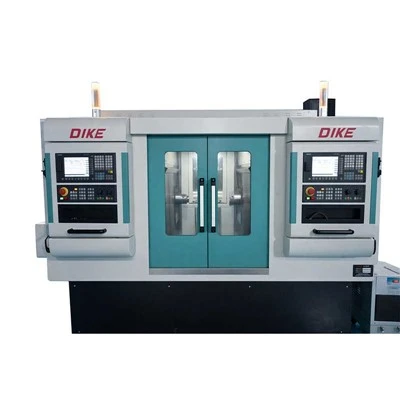
Double-spindle CNC Lathe References
- Manufacturing Engineering and Materials Processing, Volume 3: Metal Cutting Theory and Practice, 2nd Edition, S. Kalpakjian and S.R. Schmid, Pearson Education, 2014.
- Vertical Turning Technology: Principles and Applications in Heavy Manufacturing, International Journal of Machine Tools and Manufacture, Vol. 52, No. 1, 2012.
- Optimization of Roughing and Finishing Operations in Multi-Tasking Machines, Journal of Manufacturing Processes, Vol. 28, 2017.
- Heavy Machining: Rigidity and Process Efficiency, American Society of Mechanical Engineers (ASME) International Manufacturing Science and Engineering Conference, 2019.
Wuxi DIKE CNC Technology Co., Ltd.
As one of the most professional vertical lathe machine manufacturers and suppliers in China, we have world-leading production equipment and strong manufacturing capabilities. Please feel free to buy customized vertical lathe machine at competitive price from our factory. Also, pricelist is available.
Address: No. 2, Xianshan Road, Qianqiao Street, Huishan District, Wuxi City, Jiangsu Province, China
E-mail: wxdk@wxdike.com
WebSite: https://www.dike-cnc.com/
