When I first started working as a titanium wire supplier, one question came up at least once a week from new buyers, aerospace technicians, medical device engineers, and even custom jewelry makers: “Can titanium wire really be shaped?” It’s a valid question, too. Most people associate titanium with strength and rigidity, two traits that often make materials hard to form into curves, bends, or complex geometries. But over 15 years of working with this unique metal, I’ve learned that titanium wire isn’t just strong—it’s also surprisingly versatile when it comes to shaping, as long as you understand how its properties work. Titanium Wire

Let’s start with the basics: why titanium is different from other metals when it comes to forming. Titanium has a higher tensile strength than many steels, but it’s also lighter—about 45% lighter than steel, in fact. That strength-to-weight ratio is why it’s the go-to for aircraft components and implantable medical devices, but it’s also what makes some people worry it can’t be bent or molded without breaking. The key here is that pure titanium (Grade 1 and Grade 2, the most common types for wire) is actually more ductile than many of the titanium alloys used in aerospace. Ductility is the ability of a material to deform under stress without fracturing, and that’s exactly what you need for shaping wire.
I’ve seen this firsthand with Grade 2 titanium wire, which I supply to a company that makes custom orthodontic archwires. A few years back, their team was using stainless steel for a new line of flexible archwires, but they switched to titanium after they realized titanium would hold its shape longer in the mouth and cause less irritation. Their challenge was bending the wire into precise curves that matched individual patients’ dental arches, with no cracks or weak points. At first, they tried cold bending—just bending the wire by hand with a pair of pliers—and they kept getting tiny cracks along the bend line. We worked with them to adjust their process, and we explained that cold forming works best if you use the right amount of force, apply consistent tension, and even anneal the wire first if needed. Annealing is the process of heating the wire to a specific temperature (around 700°C for Grade 2) and then cooling it slowly, which relieves internal stress and makes the metal much easier to shape. Once they started annealing their wire before bending, their crack rate dropped to near zero, and they’ve been using our titanium wire for that product ever since.
Another common shaping method for titanium wire is hot forming. This is especially useful for thicker wires (1mm and up) or for complex shapes that require more deformation. Hot forming works because heating the titanium reduces its yield strength— the amount of stress needed to make the metal permanently deform—so it bends more easily without cracking. I supply wire to a manufacturer of motorcycle exhaust systems, where they use 2mm diameter titanium wire to make custom exhaust hangers. These hangers need to curve around the motorcycle frame, and the team there found that cold bending the thick wire was too labor-intensive and often led to uneven bends. We recommended hot forming: they heat a section of the wire with a propane torch until it’s cherry red, then bend it to the desired shape with a hydraulic press. This method works quickly, produces consistent bends, and doesn’t compromise the wire’s strength once it cools. We’ve also tested this with Grade 5 titanium wire, which is an alloy of titanium and aluminum/vanadium, and while it’s stronger than Grade 2, hot forming still makes it shapeable as long as you don’t overheat it (overheating can make the alloy brittle).
But shaping titanium wire isn’t just about bending. It’s also about other forms of deformation, like twisting, coiling, or even drawing thinner wire from a thicker rod. Drawing is a process where you pull a thicker wire through a series of dies (small holes with decreasing diameters) to make a thinner, more uniform wire. Our company draws titanium wire down to as small as 0.05mm in diameter, and that’s a form of shaping too. I’ve had a customer who makes tiny titanium springs for medical sensors, and they needed wire small enough to fit inside a catheter. We drew our Grade 2 wire down to 0.08mm, and their team was able to coil it into precise springs that worked perfectly in their devices. The key to successful drawing here is using lubrication—we use a titanium-specific lubricant that reduces friction between the wire and the die, which prevents the wire from breaking during the drawing process.
Of course, there are limits to what you can do with titanium wire. One mistake I see new buyers make is trying to shape it too quickly, or using a method that’s not suited to the grade. For example, Grade 7 titanium (which has palladium added for corrosion resistance) is less ductile than Grade 2, so it needs more careful annealing before bending. If you try to shape Grade 7 without annealing, you’re much more likely to get cracks. Similarly, titanium wire that’s been work-hardened (already bent or stretched multiple times) can become brittle, so it’s important to anneal it again if you need to reshape it. Work hardening happens when you deform the metal at room temperature, which aligns its grain structure in a way that makes it harder but less ductile. Annealing reverses that, making the metal soft and shapeable again.
Another consideration is surface finish. When you shape titanium wire, especially with cold forming, the surface can develop tiny imperfections if you use the wrong tools. That’s why we supply wire with a smooth, polished surface finish, which not only makes it easier to shape but also improves its corrosion resistance and durability. For customers using titanium wire in medical or aerospace applications, a smooth surface is non-negotiable—any imperfections could become a point of failure or cause irritation in the body. We also offer custom surface treatments, like pickling, which removes any surface oxides that form during manufacturing, making the wire even more workable.
I should mention that I’ve also seen some misconceptions about titanium wire shaping. A lot of people think titanium is too fragile to bend into complex shapes, but that’s not true. I supplied a small jewelry maker last year who wanted to make custom titanium rings with twisted bands. They used 1mm diameter Grade 2 wire, and they twisted it by hand with a vice and a pair of pliers. It took a few tries, but they were able to get clean, tight twists without any cracks. The key was that they used a soft grade of titanium and took their time, applying consistent force instead of rushing. That’s a big takeaway: shaping titanium wire isn’t about brute force, it’s about working with the metal’s properties.
Over the years, I’ve also seen advances in shaping technology that make titanium wire even more versatile. CNC bending machines, for example, can bend titanium wire into extremely precise, complex shapes with minimal waste. A customer in the automotive industry uses CNC bending on our 1.5mm Grade 2 wire to make brackets for electric vehicle batteries. The machine bends the wire into custom angles and curves with tolerances of less than 0.1mm, which is critical for fitting the brackets correctly around the battery cells. Before they started using CNC bending, they were doing it manually, which was slow and had higher error rates. Now, they can shape hundreds of wire pieces a day, all with the same precision.
Another advancement is 3D forming, where you can shape titanium wire into three-dimensional geometries, not just flat curves. I work with a company that makes titanium wire baskets for lab equipment, and they use a process where they bend the wire into a cube shape with precision bends at each corner. The 3D forming method uses a combination of heat and CNC pressure, which ensures each bend is uniform and strong. The finished baskets are lightweight, corrosion-resistant, and hold up well in autoclaves, making them perfect for medical labs.
So, to circle back to the original question: Can titanium wire be shaped? Absolutely. The answer depends on choosing the right grade of titanium, using the correct shaping method (cold, hot, drawing, CNC bending, etc.), and taking steps to maintain the metal’s ductility—like annealing when needed, using proper lubrication, and avoiding work hardening. As a titanium wire supplier, I’ve worked with customers across industries to shape our wire into everything from orthodontic archwires to motorcycle exhaust hangers, medical springs, and automotive brackets. Each project has taught me something new about how titanium behaves, and it’s clear that this metal is more versatile than many people give it credit for.
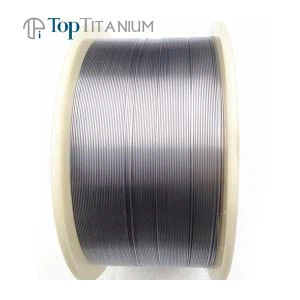
If you’re working on a project that requires shaped titanium wire—whether it’s for aerospace, medical, automotive, jewelry, or another industry—chances are we can help. We offer a range of titanium wire grades, diameters, and surface finishes, and our team has decades of experience working with customers to shape wire to their exact specifications. Don’t hesitate to reach out to discuss your needs, whether you’re looking for a small custom order or a large volume supply. Together, we can find the right way to shape titanium wire for your application.
Seamless Titanium Tube References
- “Titanium Alloys: Properties and Applications.” ASM International, 2019.
- “Forming and Shaping Titanium Wire.” Titanium Industry Association, 2021.
- “Ductility and Work Hardening in Metals.” Journal of Materials Engineering, vol. 42, no. 3, 2020, pp. 45-52.
- “Medical Titanium: Processing and Applications.” Biomedical Materials Science, vol. 18, no. 2, 2018, pp. 112-127.
Baoji Top Titanium Industry Co., Ltd.
As one of the most professional titanium wire manufacturers and suppliers in China, we’re featured by quality products and good price. Please rest assured to buy bulk titanium wire in stock here and get quotation from our factory. Customized orders are welcome.
Address: No. 2, South Section Of Phoenix 2nd Road,High-Tech Zone, Baoji,Shaanxi, China (Mainland)
E-mail: sales@bjtopti.com
WebSite: https://www.china-topti.com/
