If you’re a fire safety professional tasked with protecting sprawling industrial facilities, agricultural fields, waste management sites, or even large outdoor public spaces like airports or stadiums, you’ve likely spent late nights troubleshooting gaps in your coverage. I’m [Your Name], part of the team that designs and supplies fire monitoring systems built exactly for those open, high-stakes environments—and over 12 years on the job, I’ve seen firsthand how traditional fire detection tools fall flat here. Smoke detectors, for example, work great in enclosed warehouses but can’t spot a small grass fire burning 200 yards away; sprinkler systems require physical contact to douse flames, so they’re useless until a fire is already advancing. That’s why our focus at [Your Company, No Name] has always been solving that core problem: how do fire monitors reliably detect fires in large open areas before they become catastrophic? Fire Monitor
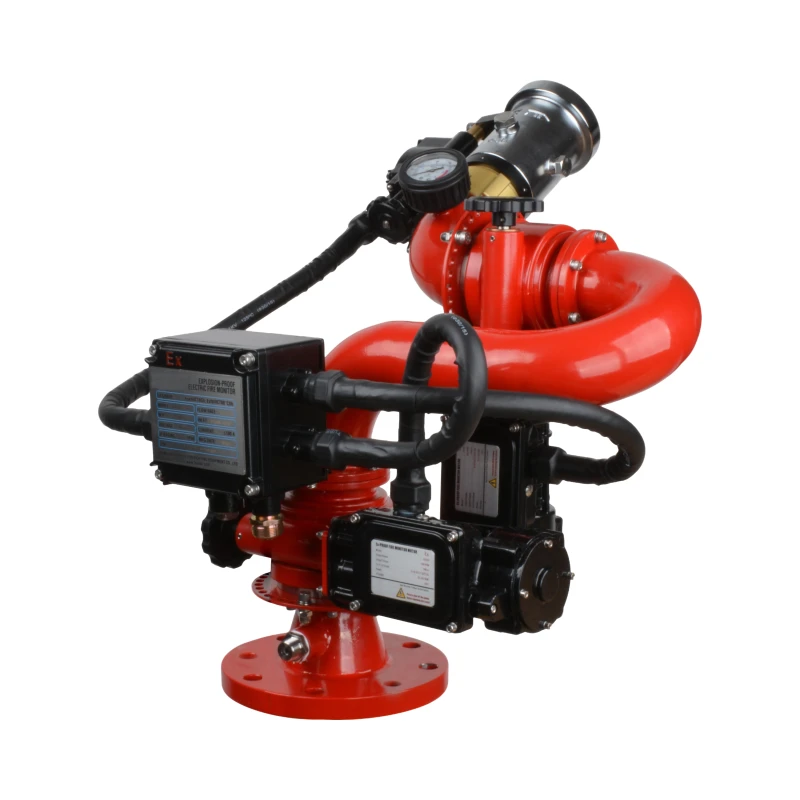
Let’s start with the basics: a fire in an open space doesn’t act like a fire in a room. In enclosed spaces, smoke and heat build up near the ceiling, so point detectors work because they’re close to that concentrated output. But in a 100-acre lumber yard, a fire could start in a pile of 2x4s, send smoke drifting into the wind, and heat rising too fast to register at a single point—especially if a gust of wind splits the smoke plume or a low sun creates thermal interference. Early fire detection here means catching the tiny, low-energy signals a fire emits before it grows to the size that can trigger slower, less sensitive tools. That’s where modern fire monitoring systems blend three complementary detection technologies, not just one, to eliminate blind spots.
First, thermal imaging cameras have been a game-changer for open areas, and we’ve refined their use a lot over the last decade. Older thermal cameras only detected temperatures above a set threshold—like 150°F—but that’s too low; a stray piece of hot metal, a sun-warmed rock, even a faulty transformer can trigger a false alarm. Our systems use “differential thermal profiling,” which compares the current temperature of every pixel in the camera’s field of view to the average temperature of that exact spot over the past 24 hours. If a patch of grass that’s consistently 80°F suddenly spikes to 180°F, that’s not a natural heat change—it’s a fire starting. We calibrate this for different environments, too: for a citrus orchard, we set a lower temperature threshold for leaf heat (since citrus leaves often run a bit warmer than grass), and for a steel mill’s outdoor storage yards, we filter out hot metal shavings that would trip old cameras. Unlike thermal cameras that just take snapshots, our cameras stream 30 frames per second, so they can track a flame’s movement across 500 yards of open field in real time, not just spot a static hot spot.
Second, we pair thermal imaging with UV (ultraviolet) and IR (infrared) flame sensors. Wait, let’s clarify: UV sensors work by detecting the unique radiation emitted by a flame’s combustion reaction—specifically, the short UV wavelengths produced when flammable gases burn. Small fires, like a campfire or a smoldering trash pile, emit a lot of this UV radiation, which makes UV sensors great for spotting fires before they produce a lot of smoke or heat. IR sensors, on the other hand, detect the longer IR wavelengths that flames emit as they grow; they’re less prone to false alarms from sunlight or artificial lights, which don’t emit the same specific IR signature as fire. Here’s the key: we mount these sensors at two different heights on our fire monitor units—10 feet off the ground for close-range detection (up to 100 yards) and 50 feet up for long-range coverage (up to 750 yards). That way, a fire starting near the base of a stack of pallets is picked up by the low-mounted UV/IR sensors, while a fire burning on a distant hillside is caught by the high-mounted thermal cameras. No more gaps between coverage zones.
But even the best sensor tech means nothing if it’s not integrated with smart analytics. That’s the third, often overlooked, piece of the puzzle. Our systems run on edge computing—meaning the processing happens right at the monitor, not in a cloud server miles away. That cuts out the lag that used to happen when cameras sent footage to a remote location; now, alerts go off in 2 seconds or less, which is critical for fast-spreading grass or brush fires. The analytics also use historical fire data specific to the customer’s site: if a customer’s waste management facility often has small, low-energy fires from burning trash, the system prioritizes UV signatures over thermal; if they’re in a snowy area where sunlight reflects off snow to create false thermal spikes, it adjusts the temperature baseline to ignore that reflection. We’ve even added a machine learning layer that learns the site’s unique nuances over time: it’ll learn that a particular oak tree always hits 100°F at 2 p.m. in summer, so it won’t flag that as a heat anomaly, but it will spot a 120°F patch right next to that oak at the same time, which is a clear fire signal.
I can’t tell you how many times I’ve heard customers say, “We just need something that works when we’re not there.” For facilities that run 24/7, having a human guard patrolling 100 acres is impossible—they can’t be in two places at once, and fatigue leads to missed fires. Our fire monitors are designed to operate autonomously, with optional remote monitoring support if a customer wants a team to watch their feeds off-site. When a fire is detected, the system doesn’t just send a generic “fire alert” email; it pinpoints the exact GPS location, shows a real-time video feed of the fire, and even estimates its size and direction of spread based on wind data pulled from the site’s weather station. That way, first responders don’t waste time driving around the site looking for a fire; they know exactly where to go.
But no system is perfect, and we’ve built our monitors to adapt to edge cases. What about heavy fog that blocks thermal cameras? We include laser-based gas detectors that pick up the faint plume of flammable gases that a fire emits before it becomes visible. For areas with lots of artificial lighting, like airport perimeters or stadium parking lots, we fine-tune the UV/IR sensors to filter out that light, which used to trigger thousands of false alarms for our early customers. We’ve also tested our systems in extreme conditions: last year, we installed units at a lumber yard in northern Minnesota that sees -20°F winters and 100°F summers, and they still work reliably, no frozen sensors or weather-related glitches.
A common question we get is, “How does this compare to other options like drone monitoring?” Drones are great for ad-hoc patrols, but they can’t be on site 24/7—they need a pilot to fly them, battery swaps, and they have blind spots when they’re not in the air. Our fire monitors are fixed, permanent units that can be scaled: a customer with a 1,000-acre farm might need 4 monitors spaced 1 mile apart, while a 10,000-acre waste site might need 12. They’re also a one-time investment, unlike drones that need ongoing maintenance and training for pilots.
We don’t just sell hardware, either. We work closely with each customer to design a custom coverage map specific to their site: if they have a high-risk zone, like a pile of flammable chemicals, we mount an extra sensor to that area to give it extra detection priority. We also provide annual calibration checks and software updates, so the system evolves with their site’s needs. Last quarter, a customer who has a solar farm installed our monitors after a small brush fire damaged 10 acres of panels; we adjusted the system to prioritize low-lying vegetation near the panels, so any fire starting in that zone is detected 30 seconds earlier than the rest of the site.
I think a lot of people take fire detection for granted, but when you’re protecting something as valuable as a customer’s life’s work, a fire that starts in an open area can turn into a disaster before anyone even sees it. That’s why our team is constantly testing new tech—last year, we started integrating LiDAR into our monitors to create 3D maps of the site, so the system can tell the difference between a fire and a tall grass clump, or a pile of debris. It’s all about closing the gaps that old systems leave open.

If you’re responsible for a large open area’s fire safety, and you’re tired of false alarms, missed fires, or systems that don’t hold up to the space you’re protecting, we’d love to talk through your needs. Whether you’re a farm, industrial site, airport, or public space, we can design a fire monitoring system tailored to your unique risks. Our goal isn’t just to sell a product—it’s to give you peace of mind that your site is protected, 24/7, no matter how big or open it is.
Fire Protection Valve References:
- US Fire Administration. (2022). Fire Detection Systems for Large Open Spaces. National Fire Protection Association.
- International Association of Fire Chiefs. (2021). Autonomous Fire Monitoring Technologies for Wildland and Industrial Sites.
- Journal of Fire Protection Engineering. (2020). Comparative Analysis of Thermal, UV, and IR Flame Sensors in Outdoor Environments.
- Occupational Safety and Health Administration (OSHA). (2019). Fire Safety Guidelines for Large Outdoor Industrial Facilities.
- National Institute of Standards and Technology (NIST). (2021). Edge Computing Applications for Fire Detection in Remote Locations.
Nonfir Automatic Sprinkler Co., Ltd.
As one of the most professional fire monitor manufacturers and suppliers in China, we have world-leading production equipment and strong manufacturing capabilities. Please feel free to buy advanced fire monitor at competitive price from our factory.
Address: No.8, Yuanfeng Road, Meiyuan Village, Kangmei Town, Nan’An City, Quanzhou City, Fujian Province, China
E-mail: info@nfsprinkler.com
WebSite: https://www.nonfirsprinklers.com/
